黄飞鸿
China’s market structure improves in H1 as AI, robots drive emerging industries_我的网站

一 | AI摘要
2026年福马女生夏令营在福州开营,36名福州与马祖少女开启5天交流研学。
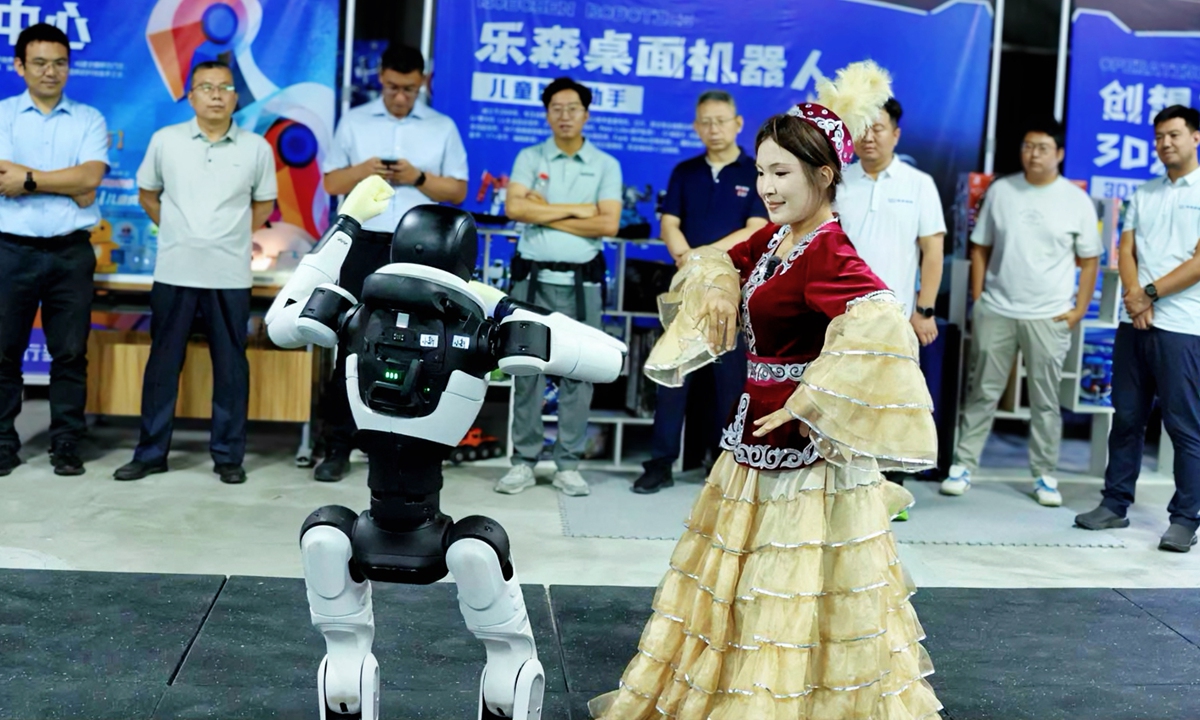
A Xinjiang local resident dances with a robot at the temporary exhibition hall at the region's first robotics 9S center on July 31, 2026. Photo: courtesy of the Xinjiang Future Era Information Technology Co, the operator of the project
China's market landscape experienced a structural optimization in the first half of 2026, powered by a lineup of emerging and future-oriented industries.
Official data from the State Administration for Market Regulation (SAMR) shows 561,000 new enterprises were registered across China's strategic emerging and future industries, spanning next-generation information technology, high-end equipment manufacturing, generative artificial intelligence (AI) and humanoid robotics.
The rapid expansion of these new market players is revamping China's industrial layout and fast-tracking the cultivation of new quality productive forces, underpinning steady high-quality economic upgrading, experts said.
Cutting-edge technology sectors stood out as the brightest growth spots, posting explosive year-on-year expansion. The generative AI industry recorded a 28 percent surge in new start-ups with 55,000 newly established firms, while the humanoid robot sector saw a 9.5 percent rise, adding 116,000 new enterprises.
"It shows that China's innovation momentum is exceptionally strong and remarkably broad-based — a trait that is virtually unique in the global landscape," Chen Jing, a vice president of the Technology and Strategy Research Institute, told the Global Times on Sunday. "The explosive growth of new enterprises in AI and robotics reflects the extraordinary depth and diversity of China's industrial ecosystem."
Outside high‑tech sectors, 3.957 million new services‑sector enterprises were established and booming emerging‑consumption businesses injected fresh impetus into domestic demand, the SAMR said.
The number of new firms in software and telecommunications services rose 3.3 percent to 322,000. Inspection‑and‑testing businesses soared 43.9 percent, and entities dedicated to the commercialization of scientific‑research achievements climbed 6.8 percent to 459,000.
Manufacturers accelerated industrial upgrading with companies moving up the value‑chain ladder, the SAMR said.
High‑end equipment industries have maintained growth during the first half, with 28,000 newly registered firms and a year‑on‑year increase of 2.5 percent.
A total of 330,000 high‑tech‑manufacturing enterprises were operating as of the end of June, including 15,000 newly established ones. Start‑ups engaged in the production of spacecraft and launch vehicles rocketed 185.7 percent. New producers of fiber optic cables climbed 129.4 percent and integrated‑circuit businesses increased by 24.2 percent.
"We are witnessing a dual-engine growth model, where new consumption in the services sector and high-tech services reinforce each other, while the digital and real economies integrate at an accelerating pace. At the same time, the intelligent transformation of manufacturing is picking up speed," Chen said.
The dividends from this industrial transformation are generating a powerful multiplier effect, creating a virtuous cycle led by innovation, Chen noted.
"The first‑half growth and structural shifts among China's market‑based businesses mirrored the country's overall economic momentum and industrial makeup. New‑emerging sectors, core strategic pillar industries and forward‑looking future industries registered the fastest business expansion," Tian Yun, a veteran economist, told the Global Times on Sunday.
These solid achievements fully reflect the success of China's innovation-driven economic strategy.
Strong policy support for specialized, sophisticated, unique and innovative enterprises has fueled this industrial boom while these market players have helped China shore up, upgrade and extend its industrial chains, Tian noted.
This business boom lines up with this year's stellar foreign trade figures, Tian noted.
China's exports rose 23.9 percent year-on-year in dollar terms in July, data from the General Administration of Customs showed on Friday.
Exports of high-tech products, including industrial robots and 3D printers, surged by more than 50 percent year-on-year, outpacing the 39 percent growth recorded in the first half of the year, according to the Xinhua News Agency.
The growing pool of high‑quality market players signaled lasting improvements in China's global competitiveness, industrial upgrading capacity and the standard of goods and services. Broader product ranges, better‑made commodities and improved supporting services will deliver durable new‑growth momentum, Tian noted.
。活动以“共同家园·共同记忆”为主题,通过共植榕树、探访古迹及入户体验等形式,深化两岸青少年情感联结。
8月18日,2026年福马女生夏令营在福州市海峡妇女儿童活动中心茉莉讲堂开营,36名来自福州与马祖的少女齐聚一堂,开启为期5天的沉浸式两岸青少年交流研学之旅。这是该特色夏令营连续第3年举行,今年更是首次纳入第十四届海峡青年荟系列活动。 本次活动由福建省妇联、福建省金门联、福州市妇联、福州市金门联联合主办,以“共同家园·共同记忆”为主题。启动仪式现场,最具意义的环节当属“共植家园树”。福州本地少女带来榕城沃土,马祖少女带来家乡清水,她们携手为榕树苗培土、浇灌,一举一动诠释着福马两地地缘相近、根脉相连、薪火相传的深厚渊源。随后,福建省金门联秘书长方冷为新生树苗悬挂许愿签,全体营员在榕树主题画板上共同创作“家园之树”,勾勒出两岸同胞同心同源、携手共进的美好图景。 本次夏令营围绕“家园”主线,营员们将走进螺洲古镇、福建省档案馆,探访吴石故居、研读侨批档案,从红色记忆与侨乡文脉中感悟家国一体的深厚底蕴;夜游三坊七巷、上下杭历史文化街区,感受闽都传统文化底蕴;打卡福州熊猫世界、福建省气象局,近距离了解生态保护与气象科普知识,共护共同家园。 活动还特别设置结对入户体验环节,两地少女将走进福州本地家庭,携手烹制家常菜、围坐聆听两岸温情故事,在烟火日常中感受邻里温情与家园温度,并用镜头记录闽都人文风貌,定格共同的青春记忆。(记者 林铭)。
Current article:http://1zcwi.minpinpengcemiuanjiuxuan.pics/vzpu/20260826/64280.html
Published on:05:05:11